So it's been a while since I last updated. Classes have begun, I've gotten my living situation more or less figured out, and I'm learning how to buy things.
One of the most immediate challenges I faced was how I was going to bake things. There's no oven in this room, as I think I mentioned earlier. I've asked around a lot, and all I've found on campus is toaster ovens and broilers. So, I've adopted desperation measures inspired in part by the Boy Scouts: I've been baking in a pot. I have a tall pot, which apparently allows for decent convection, and I put rocks in the bottom, put a plate on the rocks, and then put my baking pan on the plate. I have one baking pan, a small round tin with a removable bottom that leaks if you use a thin batter, so the plate is good for catching that. Preliminary experiments used a shorter pan and baked directly on the plate, and those didn't turn out as well. I call this a desperation measure, but it's working really pretty well, so I'll stick with it. I want to someday make a Toll House Bundt Cake, but that requires butter, which is expensive. I think I'd also want to stick to the bundt shape, which would require getting another pan, but I ought to be able to find one of those for pretty cheap. You can find most things at the ¥100 shop; that's where I got the pan I have now. It's been working surprisingly well. I should probably make biscuits again soon; I baked all those directly on the plate, so I'm interested to see how they do with my improved methodology.
I haven't gotten pancakes to work exactly right, not yet. The flour here is ground more finely than I'm used to, and it does wierd things. The first being that all my columetric measurements don't work, and I need to measure by mass, so I bought a small kitchen scale (again at the ¥100 shop) and have been using that. It worked fine for hot water cake, but I needed to add more than I measured for Banana Muffins (well, muffin loaves, as the case may be), and my pancakes were still too thin. They're more like Crepes. They taste fine, I eat them, but they're as big as a plate. It's weird. I'm just going to add in more next time.
Classes have begun. It seems that they will be mostly useless. I have two classes I like, maybe a Japanese language class that is okay, and that's about it. The two classes I like are both taught by a Brit, Robert Aspinall, and are Education in Japan and Modern Politics in Japan. Even here, though, Prof. Aspinall tends to belabor his points a bit, and I can zone out for stretches without really missing much. The classwork is very light; we have two graded assignments, a presentation and a report. Neither should be too hard. I just need to remember to do them when my time comes. Contemporary Japanese Society, the one non-language class that I don't really like, has a different speaker on a different topic every week. Oh, yeah, all classes meet once a week. They're not very substantial. So this Contemporary Japanese Society class seems like it'll lack focus, but it might end up being interesting sometimes. We'll see. Because my classes meet so seldom, it's hard to get a good feel for what they'll be like, even now. Most of my Japanese Language classes, though, are kind of a bust. There's not much emphasis on recombining things you know into novel phrases, which is the heart of language use. There's a lot of repeating things. We have a "conversation class" that consists largely of taking an example template sentence and replacing underlined words and phrases with provided words and phrases. Pairs of students are asked, one pair at a time, to recite, to read from the book, this script, replacing the phrases as necessary. Sometimes, the last pair is requested to improvise. This class is USELESS. Talking about it makes me angry. It does NOTHING for the students. It teaches NO valuable skill. Conversation do not follow a script. You are not teaching us to use the Japanese language, you are teaching us to say the Japanese language. The second a mark goes off-script, we the students are left unprepared. We have a listening class, which consists of listening to tapes and trying to transcribe what we hear. This class is kind of silly because, being in Japan, we should be listening to Japanese all the time. This, sadly, is not the case, as there are relatively few outstanding opportunities to interact with the Japanese population in Japanese. Foriegn students are in kind of a world of their own, and the language is predominently English, which is unfortunate because I don't even get to practice my French or anything. There are some French people here, but I don't have much of an opportunity to interact with them, and when I do try to speak French with them, they respond in English. It's wierd. I'm making steps to get more Japanese Language Exposure, and the exchange program provides a "tutor" whose main duty is to meet with a student each week for an hour and just chat and make sure that things are going alright, so I've been getting some practice in that way. I've also been slowly milling my way through the latest issue of Yurihime, which I bought a few weeks ago. It's rough going; there are just so many Kanji to learn, and the weird thing is that it can be hard to tell what to remember. In practical use, I don't need Kanji, I need words. One of the primary ways I tend to absorb words is through reading; to get words through reading, I need Kanji. So right now, I've given up on trying to remember Kanji per se, and I've especially given up on trying to be able to reproduce them. Right now, I'm focusing on reading them and remembering the words they represent. Sound and meaning; image will follow (maybe). Not being able to read has been a very frustrating experience, so I want to correct that as soon as possible. And when I was learning French, I had access to a host of cognates that made expressing my self relatively easy, but I have no such luck in Japanese. This was one of the reasons I wanted to learn Japanese, acutally, because it was a language that was more different from English than French. The wierd thing is that Japanese morphology (形態学, I'm trying to remember that one) is tied to Kanji, so remembering Kanji will, in theory, help understanding and production of new words. In practice, that hasn't been too true, though, which is one of the reasons that I've made remembering them second priority. Japanese phonology (印音楽) doesn't help, either, because remembering a word consists mostly of trying to remember which of Japanese's less-than-one-hundred cannonical sylables comes in which order. So it's taken me a long time to remember the word for "maintain" because it's been hard to remember if it's mo-ta-tsu or ta-mo-tsu or to-ma-tsu or what (It's ta-mo-tsu, 保つ, I got it now). Consonant clusters make memorising things so much easier. But I'm making progress. I'm constantly trying to remember how I'm stacking up against when I was learning French, but the environments are too different and I can't remember how well I was really doing in French. I always feel like I was making faster progress in French, but that's hindsight and with a decent competency in French already under my belt (albeit declining. Dang, how can I talk to some French people in French?). It is unfortunate that this environment is so much less immersive. I've joined a Jazz club, so that's good, and providing me with some good social contact and practice. It looke like I might not get to play in any groups, however. I have a loaner trumpet, which is nice, and I've been practicing pretty regularly. The club meets twice a week, once on Wednesday and once on Saturday. My experience in these times has been primarily being taken aside by on older student, a sempai, and doing drills lor reading sheet music. LAst Saturday, there was a rehearsal, and I sat in on that, but I know they have combos, not jsut a big band, and I wonder when they meet. Last Wednesday, partway through the rehearsal, a sempai asked, "Are there any first-years who want to go watch a rehearsal?" And it turned out that in a slightly different location, there was a big band rehearsal going on. I should have noticed that some of the other club members had gone missing. So apparantly the band rehearses with the relevant members while everybody else practices on their own? When do they get new literature? I doubt I'll be around long enough to either get an opening or, if I do, to stay around long enough to make a difference, assuming I'd actually be granted a chance to play. A combo would be more promising. I guess I'll ask about those in a week or two provided no information is forthcoming.
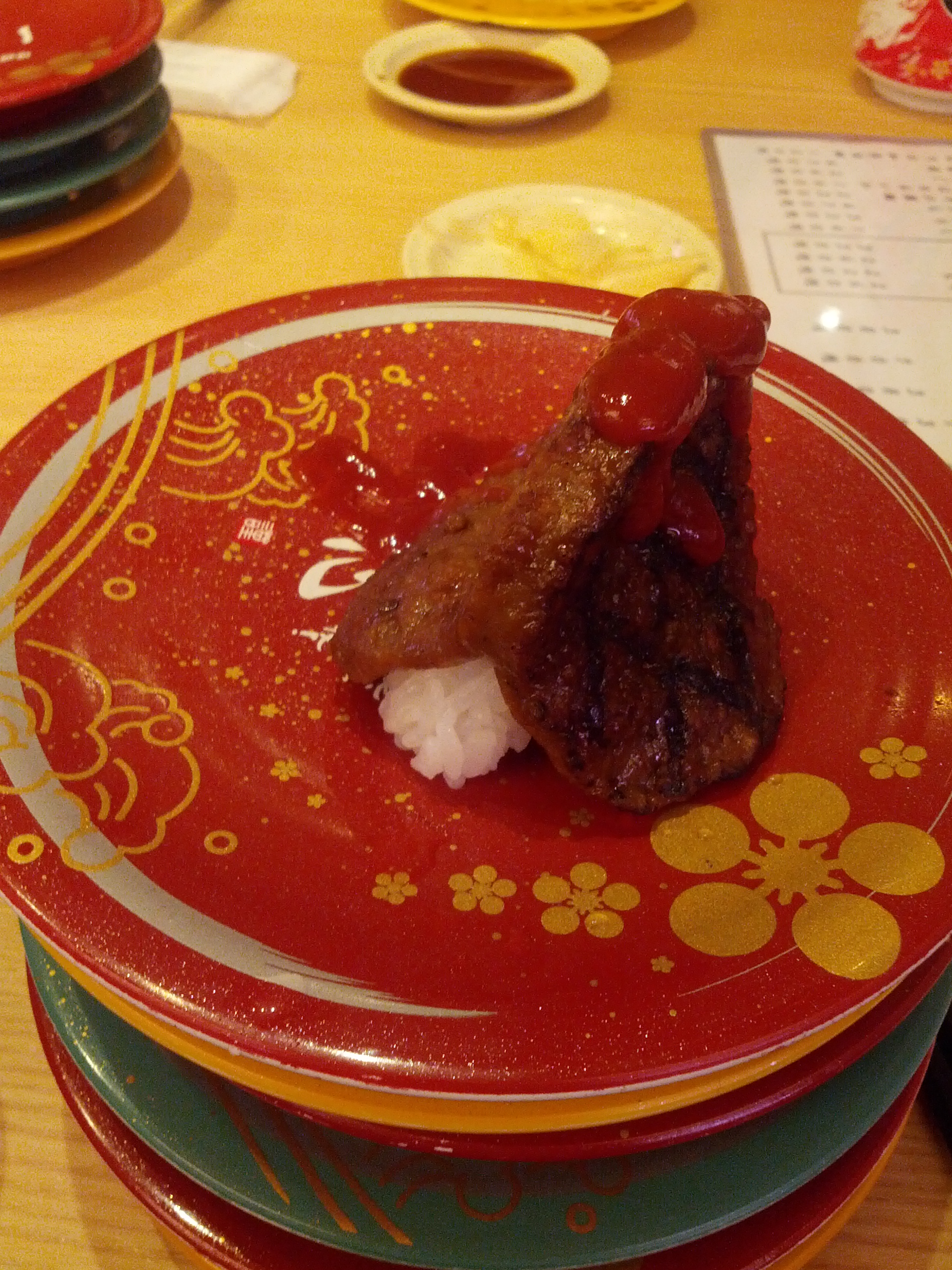
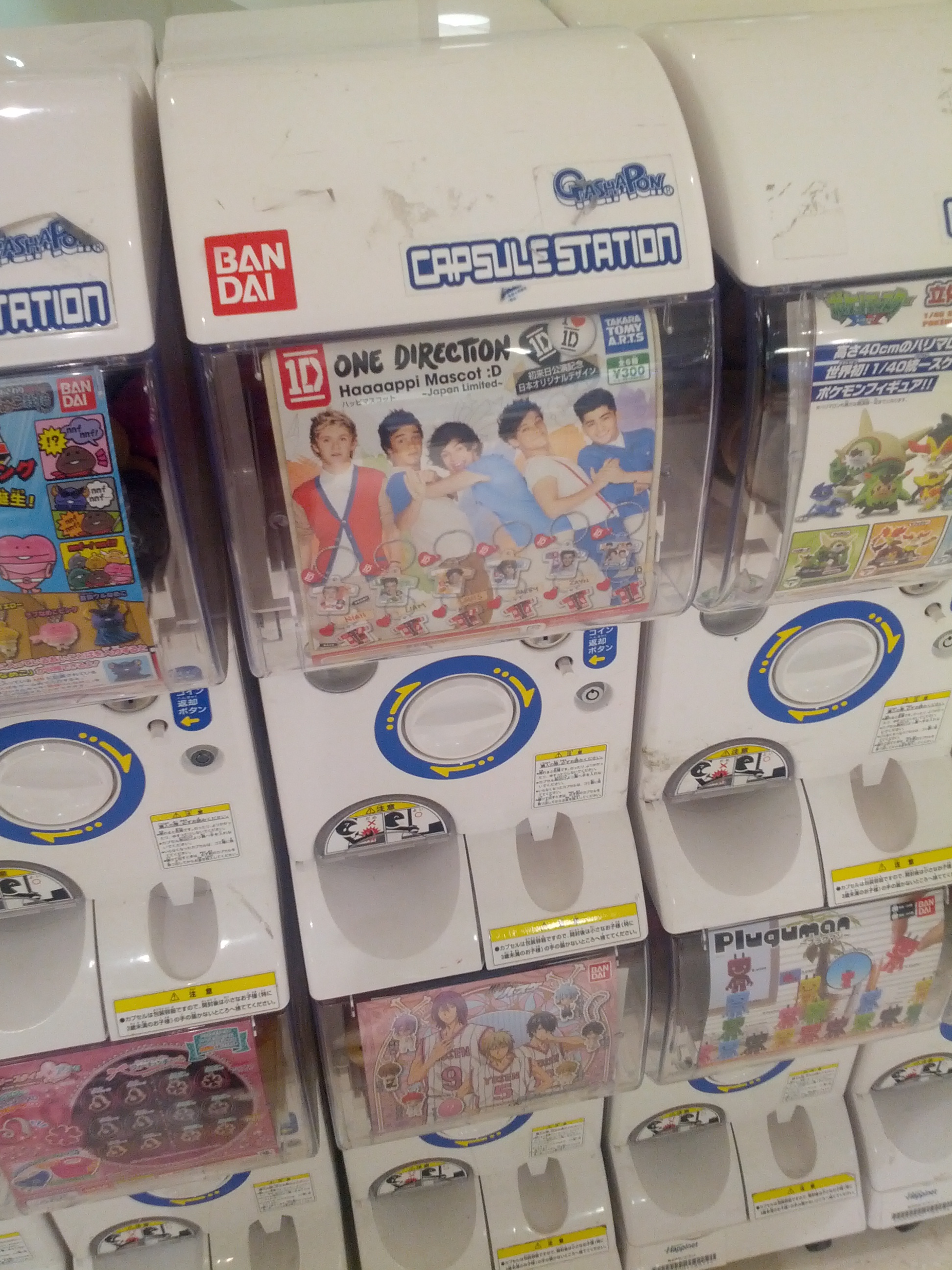
Outside of that, I've had some contact with the other Expats. This is unavoidable, as the building I live in is occupied primarily by them. This is one of the reasons that it's hard to make Japanese social contacts. There's no common space to share with Japanese people. There's little chance for incidental contact, which is one of the things that matters most when making friends and building social contacts. I've fallen in with a crowd consisting not of short-temp NUPACE students, like myself, but longer-term I think graduate students consisting of a Romanian, two Brazilians, and sometimes some Philippinos. I am the only boy. Tomorrow, we're going to the zoo. I think they have Koalas there. Last week, we went to the mall and had sushi, including this hamburger sushi. X on sushi rice is "X sushi." The hamburger sushi was really pretty good. Not bad hamburger. The mall also had a game center, a super-sized version of the paltry offerings one might find at an American mall. There were a lot of lottery games, like crane games and wierd ticket machine-type things, a lot of rhythm games, DDR and Beatmania and Taiko drumthing, and two-or-three-button branded rhythm games. What's Aikatsu? It seems popular. There were also a whole big bunch of gashapon machines, including a One Direction gashapon machine, seen here directly over a Kuroko no Basuke machine. Judging by frequency of gashapon machines, Kuroko no Basuke is surprisingly poopular. This place also had a good few Natsume no Yuujinshou machines and a ~Monogatari machine where all the characters were blockheads, like they had all been sucked into Mine craft, and one Madoka Magica machine that had figures of all the five girls and Kyuubei, figures that, if the photos were any indication, were designed to sit on the rims of drinking glasses. I don't know why this is appealing, exactly, but I would have taken a shot at the Kyuubei one as a souvenir for John if they hadn't cost ¥400 a peice. Yeesh.
So that's the exciting news this time. I'm sure I've forgotten stuff, and let me know if there are any details that you're curious about. I'll try to get them out here. It's late now, and I still have to go out and buy some instant yakisoba because I don't have anything to eat for breakfast and I'm going to the zoo and then I have club. And then I want to make Onigiri so I can take them with me on the Shinkansen to Toyko on Sunday for a visit to Akihabara and maybe Shibuya.
There's a lot to talk about; I've crossed a lot of things of my "to do in Japan" list. I'll get to those, but first I want to talk about some general stuff.
I feel like I'm at a bit of a turning point, which is one of the reasons that I wanted to update tonight, especially since I've been putting it off. I'm not happy right now. It's a feeling I've been brooding upon for a few days now, which hasn't really helped, but is also a sign that the problem is real and not ephemeral. (Though, of course, in the long run, my entire life is ephemeral.) I'm not learning Japanese. I'm not coming into contact with Japanese culture. It seems probable at this point that I'll leave Japan without ever setting foot in a Japanese house. There isn't any regular opportunity for me to listen to JApanese conversations. My Japanese language classes, which are the bulk of the classes I attend here, are useless. And mostly, my belief that learning languages is exciting and opens doors is crumbling.
When I was in Belgium, learning French did help me, because I used it every day. As my French improved, I foudn I could interact on a more meaningful level with my everyday surroundings. When all the inbound Rotary students got together, at first I thought, "Oh, cool. We're all from different places and speak different languages, but because we're all learning French, we'll be able to communicate." No. English, always. But that was only once a month. For the rest of the time, it was French, day in and day out. I could live with it. It was only a small dissapointment. There was maybe one time that I had a meaningful conversation with other inbound students in French. Any other conversation I had, meaningful or otherwise, was in English, or nearly enough. Did I speak French or English with the Japanese schoolgirls? I think French. But that wasn't very meaningful and didn't last long. Here, I once more have contact with other exchange students, on a more regular basis, seeing as we're all crammed into this building together and attend classes together. And it's always English. When I see someone in the corridors, they'll tell me "Hello," whether they're from Germany or the US or France of the Phillipines. Always English. In pasing periods between Japanese classes, the students always speak to each other in English. Sometimes I'll hear some Korean or Portugese, but for the most part, English, always English. And the thing that is starting to get to me is that these students have opened doors by learning another language. English lets them talk to people from other places. I grew up speaking English. No new doors can be opened to me. Learning another language is useless, because I already know the language that other people know. Dealing with this melancholy is probably going to define most of the rest of my stay here in Japan.
Before I move onto potential resolutions, I'd like to take a moment to complain about my Japanese language classes in detail. I feel like they in part are one of the greater sources of discontent in my life right now, because they highlight so many problems with my staying here. They aren't the principle cause, but I feel they betray many symptoms. And there are just some problems with the class itself that make me feel things that I haven't felt in a while. That I haven't realyl felt since the last time I attended Japanese language classes, really. It's been veyr interesting to note: many of the problems I have with my Japanese Japanese language classes are very similar if not identical to many of the problems I had with my American Japanese English classes. This is not too surprising when you take into account the fact that my American Japanese language classes were designed by Japanese people. It would appear that the Japanese simply do not know how to teach languages. I've been told that Japanese pedagogy tends to focus on memorization. This is somewhat problematic for me, because I'm somewhat philosophically opposed to memorization as a tool of "learning". Any idiot can remember things. Any idiot can accuulate knowledge. I want to be more than an idiot. I want to exercise my intelligence. This is something that no Japanese language class I have taken has rightly allowed me to do. I have five different Japanese classes that each meet twice a week. This is because I'm in the "intensive" class, which I took becaues it gives me a full 10 out of the minimum 15 required credit hours, and because I thought it might help me learn Japanese faster. In fact, it's only wasting more of my time. My five classes are Reading, Listening, Conversation, Grammar and Usage, and I think a second Conversation. I know one of them's duplicated, and it's either Listening of Conversation. I think it's conversation. Most of the exercises here are limited to fill-in-the-blank exercises. There's little to no excersise in creating novel utterances, which is in fact the sould of language use. Most utterances, it has been noted, have probably never been uttered before and will probably never be uttereed again. Unless you utter them during a Japanese class, it seems, in which case they will be repeated roughyl 10 times, once for each two students in the class. There's a dissapointing and alltogether puzzling (on my part) dependence on scripts, especially in one of the Conversation classes. Allow me to translate an excersize for you. Let me get my book out. Okay. Here's an excersize we did today in a Conversation class. As it was emphasizing a partiular structure in Japanese, the translation will be a bit awkward, but bear with me. It was a lesson on asking a favor from someone because someone else asked you a favor. That statement might make more sense in context. It will if I'm a halfway-decent translator, but I'm probably not. But here goes.
1."~ asked if you might ~"
Practice properly changing the underlined phrases into phrases 1-5, listed underneath this conversation.
[A...a student B...Wasuda-sensei (male)]
A: Wasuda-sensei.
B: Yes?
A: As it happens, Honda-sensei was here earlier.
B: Okay.
A: And if you could, he asked if you might come early to the conference tomorrow.
B: Oh, alright. I understand. Thank you.
A: You're welcome.
1. to come in his place to the conference tomorrow
2. to bring the materials to the conference tomorrow
3. to speak about your trip at the conference tomorrow
4. to explain the current plan at the conference tomorrow
5. to change the date of the conference tomorrow
And there it went. Not perfect, but what translation is? The way this exercise is implemented in class is that we listen to the example conversation, the one with an underline, and then the teacher will call on pairs of students to recite the script, replacing the underlined phrase with numbered phrases 1-5. Note that, becaues the exercise is done in pairs, one student playing A and one student playing B, only one student is required to do any sort of thinking, menial though it may be, by replacing the underlined phrase. The other student can just read what he's heard at least once, and probably a few times by now. After we do all five example sentences, the student reading A is required to think up something original to fill in the blank. This is as close as we get to using the language in any sort of creative capacity. There is extremely little room for exploration and error. There is always one correct answer.
As most of you can imagine, I find this kind of classwork to by absolutely mind-numbing. It teaches nothing to nobody. At any given point, most of the students are bored out of their gourd. Listening to other students reading aloud is not very educational. In that respect, it's like I'm ack in Salfelder's English class. Actually, now that I think about it, JApanese language classes are a lot more like Salfelder English than I would care for. There's a lot, a lot, of reading aloud. It's mostly useless, and a waste of class time. I feel like these teachers just might not know any other way to fill 90 minutes of class time. I like to think that maybe instead of the current approach, they could teach something, but maybe that's too ambitious. I like to think the reading class is okay, but that's mostly because we get to read stuff, and I love reading. I had a reading class this morning, and it actually kind of sucked. The class itself is boring. I just like the assignments. The other reading period I have is maybe the best Japanese language class I have, consisting mostly of reading something, then answering questions as a class. Because it involves direct and immediate feedback regarding interpretation of the text no matter who happens to to be reading aloud, it can sometimes keep me interested. The other Conversation class I have is interesting because it's project-based, and involves going out and speaking to Japanese people. Previously, I went to the Tokugawa Art Museum, and, I think mostly through a series of misunderstandings, landed an interview with a curator, which I recorded and later transcribed, which was a long and painful, but rewarding task. It might have been mostly unnecessary, but it probably helped with something. Our next project involves administering a survey to Japanese people, which we will present on later. Part of me rails because we're not going to get a meaningfully large or variegated sample to mean anything, but this is a Japanese class and not a sociology class, so it's not a big deal. Anyway, that class is alright. It has the right idea, at least. The "Grammar" class is more like a "usage" class, and it's okay, I guess, but I can work ahead to a ridicukous degree. All the in-class work is in a booklet that was distributed at the beginning of the class, and whenever we do exercises during class, I can do them faster than the class as a whole does them and then reads through them aloud, so I just move on to the next exercise and follow the directions, which are usually clear enough. The fact that we have a Listening class at all is a sad comment on the fact that we get practically no listening experience in daily life. We are in a country that speaks the target language, but we don't get to hear it on a regular basis. Fixing this is, I think, one of the most important things I can do to try to improve my Japanese language skills. Right now, I don't know what Japanese is supposed to sound like when spoken to real people. I know far better what it sounds like when it's been hacked into a script. After that brain-dead replacement exercise this morning, part of the typical regimen, we moved on to just reciting the same conversation over and over with a partner, another typical thing to do. And I hate it. I really, really hate it. It makes me rage. When it happens, I want to punch something, or someone, or jump out a window. It would be nice if I could just throw my booklet at the teacher and scream and generally throw a tantrum, but that's not a graceful option.
But here's the thing that really gets me, and it's one of the few things that, maybe, my American Japanese language education did better than my Japanese Japanese language education: the teacher is constantly speaking English. If English was the language of instruction, this would not be too bad, in my opinion (it's far easier to talk about a second language using a known language, and translation exercises, a thing I have never known in Japanese language study, are incredibly useful for demonstrating how meaning maps onto words and phrases as well as allowing a precise tool for measuring comprehension and asking questions), but Japanese is the language of instruction. The teacher will commonly throw in English translations alongside Japanese words, or simply use an English term instead of a Japanese one, even if that English word is not in common Japanese use and there is an accepted, standard Japanese equivalent. Notable examples are the terms for verb forms. Ever since my American study, I've heard them called, in English (or Japonified English) "dictionary form," "potential form," "passive form," and "causative form." However, our booklet does not use English-language terms. It uses the JApanese terms 辞書形, 可能形, 受身形, and 使役形. The teacher never uses them. She keeps speaking English. Its the same for parts of speech: "naun," not 名詞, "baabu," not 動詞. I don't know why. When there's a difficult word, many times it will always be accompanied by its English equivalent, if not replaces wholesale. Here's an example I get the feeling I'll be using regularly. One day, the lesson was on modifying clauses, 修飾部分 shuushoku bubun. Towards the beginning of class, the teacher asked (and forgive the bastard language mixture, but it's hard to try to convey this otherwise), "So today we're going to talk about shuushoku bubun. Does everybody understand shuushoku?" And at this point, you know, everybody's looking in every direction, and not responding, because no one can answer for everyone, and when I try, the teacher doesn't believe me and gives an explanation anyway, so she says "moudifai." And from that point on, I guess she knew ("knew") that everyone did not understand the work 修飾, so she always used the English term "moudifai." To give you an example of what this sounded like to me, I give you an example paraphrase in Japanese: "でもこのPHRASEはMODIFYしない。このPHRASEは普通だから、つぎのPHRASEの関係ありません。先のPARAGRAPHでは初めてのPHRASEは次のをMODIFYしましたけどこのPARAGRAPHは違う。" Each occurence of English in that quotation has an accepted Japanese equivalent. Why the HELL is my teacher not SPEAKING JAPANESE? THIS IS A JAPANESE CLASS. EVERY TIME YOU OPEN YOUR MOUTH, YOU ARE PROVODING A LESSON TO YOUR STUDENTS. YOU ARE TEACHING YOUR STUDENTS TO SPEAK A BASTARD LANGUAGE THAT JAPANESE PEOPLE WILL NOT UNDERSTAND. You are INHIBITING your students absorption of the target language. You are PREVENTING them from becoming facile with Japanese terminology. You do NOT know how to teach your material. And I am ready to punch someone, or everyone. After that class, I asked the teacher, "Sensei, is "MODIFY" a word that's commonly used in Japanese?" She told me, "Oh, not, it's not." and I just said, "Oh, thank you. Excuse me, then," and left the classroom. That was the time when I became painfully aware of this plague, but it infests nearly all my Japanese language classes. A couple of them don't have it so bad, and might actually use a Japanese term every once in a while after giving an English translation. But by and large, it happens a lot, and I wince every time it happens. Well, it's been getting so that I don't wince any more, I just feel defeated. I just let my pencil, if I'm holding it, fall on the table, or just hold my face in my hands and wish that something educational were happening. I'm in these classrooms for three hours at the start of every weekday. I hate it. My expressions of exasperation are visible enough, apparently, that one of the most offensive teachers has taken notice and has started to preffer Japanese phrases a little more, though she's far from cured of the disease. Still, it's getting results, so I guess I should keep doing it?
But it's not just JApanese language class, it's like all the Japanese people I talk to, who are painfully few. One of my classes introduces "conversation strategies," which so far have been limited to talking about "聞き返し" kiki kaeshi. The terms means roughly "repeating what you hear." This consists of wonderfully novel suggestions such as "If you don't understand something, ask what it means," as though a person with a limited command of the language would not have thought of this on his own. The kicker, though, is that this advice is not needed. The Japanese people I interact with are typically very fond of adding in whatever English words they know when they use the Japanese equivalent, or switching to English entirely if I'm having trouble understanding something. It's a precious rarity that I have a conversation with someone that will actually try to explain things to me in Japanese. I thought I would get more chances after an early meeting of the Jazz club, when a sempai asked me to explain the exercises I did when I practiced on my own. I had to elicit the word for "vibration" (振動 shindou), which was not easy. And I thought that if I was going to have conversations like this, things would be alright, and my language skills would improve. I have not had conversations like that, and my language skills have improved very little. Once, when another JAzz club sempai was comparing bell sizes, I asked him, "are they the same size?" And he replied, "そっちのほう小さい.SMALL." My exasperation had been building for a while, so I just asked him, "How come Japanese people don't want to speak Japanese with me?" And he was confused until I managed to get out some explanatory phrase. I stutter a lot when I speak Japanese, and I haven't had much chance to smooth it out. I remember it took me about three months in Belgium before I could speak Fench fluidly, if not fluently, but I don't think I'm on the same pace here. Anyway, this sempai, Matchi-sempai, was a little downcast, and I didn't understand all of his explanation, but I know he used the word "kindness" (well, 親切 shinsetsu), and I understand that he was trying to convey that, because I didn't speak Japanese very well, Japanese people were doing me a favor by using words I could understand. These poor, misguided Asians. I explained to him that I considered it very rude. I'm trying to speak your language. I'm trying to understand you. By using words in a different language, you are denying me the chance to practice. You insist on my incompetence. You resist my efforts to learn. But I'm sure that whatever I said was far, far less elegant than that. Later, after the meeting, a Korean that I knew had decent English was talking to me about a friend who was going to West Point, and asked me where West Point was. I couldn't remember, exactly. I told him that I thought it was in North Carolina or Virginia. He then asked about rednecks, and if taking a trip there would be "安全。" I stopped to consider for a minute, and he mistook this for incomprehension, and he told me, "安全。SAFE." I did not like this. I ----ing know the word anzen. It was one of the first words I learned when I was coming over here. It's on all the little tri-folds tucked in the back of the airplane seat pockets. Later, he asked me in English, "Can you understand all of the jokes they do during announcement time?" And I replied in English, "No, I don't understand everything, but it's just important to get the exposure, especially during announcement time because nobody wants to ----ING SPEAK JAPANESE WITH ME, so I have to overhear when peopel are talkign to each other" and some other stuff. He, as well as some nearby Japanese, were a bit taken aback by my outburst, though they couldn't understand the large part of it, I'm sure, and this Korean guy said, "Oh, okay. I'll explain to the others," and gave an explanation that I couldn't entirely follow to some japanese people that were nearby, and one of them asked "Can he speak?" To which I replied, "I can speak --" at which point she interrupted, "AMAZING!" One word. I said one word, and that was amazing. Look! The gaijin knows a trick! God. I am not happy right now. Shortly after that, I had a real conversation in Japanese, one of the three or four (certainly not more than six or seven) I've had since coming here, and even though most of that conversation had an undercurrent of disappointment that these people would be so shocked that I could speak a single word of their language, I was happy that I was at least talking. So there's hope for improvement there, if I can only start talking to people. I'm not so good at that, though.
But, as I mentioned earlier, I feel that, more than getting practice speaking, I need to hear the language used in a naturalistic environment. That is how language learning happens. I have vocabulary, meager though it be, and I have grammar, enough to understand most things given time and effort, but what I don't have is usage and facility. I can put words together and they can mean something, but I don't want to sound like a Japanese version of some of the notices posted around the dorm, e.g. "The student was died." "You must not chugalug." "The checking-out will be forced to do." and others. One of my favorites is on a handout detailing things to be especially mindful of while cleaning: the Japanese title is "掃除チェックポイント," which is rather literally "cleaning checkpoint," using a Japanese transliteration of the English word "checkpoint." The English translation is "cleaning-checking point." How did this happen? As an aside, there's also a sign warning something like, "Don't pull your LAN cable out from the wall, or it could deny everyone in the building Internet." However your system is designed, if this can actually bring the system down, it's designed badly, and you should get it fixed. I feel like you have to be doing something very wrong if one unplugged cable can cascade a problem that far down the pipeline. Anyway, I don't know how Japanese people use Japanese in a naturalistic setting. I can listen to my TV shows and get some idea, but I don't want that. I want to actually know how people use the language. TV isn't real. In French, I have French filler words and colloquial transitions. In Japanese, I still want to say "Um" and "well" a lot. But I want to stop wanting that.
So what do I do? I have limited contact with Japanese people, and virtually no regular contact outside of club, which consists of primarily club activities. Japanese people don't care wether or not I learn JApanese; the fact that I can say anything is amazing, and my awful JApanese is quite frequently praised. In addition, I'm starting to doubt my initial faith that language learning is an intrinsically valuable and interesting experience, the more I see that I've known the one language that matters all along. What do I do? The two main options I see before me are "give up" and "fight harder." I know that the corrent answer is to fight harder. I can find conversations to overhear. This is the most important thing I can do. If I have to speak, that's actually detrimental. It detracts from absorbing the way native speakers use the language by forcing me to craft meaning in the absence of that knowledge. I think it's a lot like music, and I sometimes think that my "musician's ear" is an asset in learning language. In order to produce the sound you want, you first have to hear the sound you want, imediately before you produce it. If you don't listen to what it's supposed to be like, you don't know what you need to hear. So I need to overhear conversations, and evn if I don't have regular intercourse with Japanese people, I can find their secret gathering places, sit nearby, and listen. It helps if there isn't much ambient noise, but putting too many restrictions on what I can listen to might limit my options in what I can listen to. I also need less English in my life. This means limiting my access to the Internet, which was actually what happened while I was in Belgium. I never had constant access the way I do now. So I need to watch fewer Smash videos, all in English, and do more Japanese language things. Spend that time listening, or reading. God, I love reading, but reading Japanese is hard. Actually, I picked Hanjuku Joshi bak up the other night, and reading it went a lot easier than I had expected based on previous experience, which is a note of hope. But I need to be reading all the time. I love it too much, and I'm too bored a lot, so I should do it more. According to one of my teachers, there are lots of words that are used only in writing, so reading some stuff might not help too much, but the fact that most text in manga is dialogue may mitigate this problem. The fact that a lot of vocabulary I might absorb from reading will be useless in conversation is a very dissapointing thought to be, because I've learned so much eloquence and style in English from reading. I feel like my English speech changes depending on what I'm reading. If I'm reading Dickens, my speech will be more Dickensian than if I'm reading Verne. I don't care if I sound like a book; in fact, I kind of like to sound like a book. But the bottom line is that I'm not going to learn Japanese in a classroom. I think that I've gone about as far as I can with that. The nature of the classroom isn't helping very much, either. I think it's actually hurting me by sapping my motivation, by striking at the root of it. There's so much English, in signage, in the Japanese I hear, in the lessons that are supposed to teach me the langauge, that the environment here in Japan is actively, in unintentionally, hostile towards language learners. At least in my position. I've remarked that the France, the situation is the opposite. The French philosophy (which a resident Frenchman has confirmed), is "this is France, we are French. While you're here, you speak our language. This is our home turf, so we don't have to accomodate you. If you want to live here, you need to learn to speak like we do." The Japanese philosophy is much more Jewish: "you're not one of us, so the rules don't apply to you." And it sucks. If I had to deal with more Japanese people on a more regular basis, then maybe this effect would subside, maybe in part because I'd be able to speak the language better and better.
Call me Mulder: I want to believe. I want to believe that learning another language is a meaningful thing to do. But it hasn't been. I was dazzled at first by the brilliance of glimpsing another way of thinking, I was entralled, but I'm beginning to be disillusioned. These people don't want me to learn their language. I'm not supposed to. Even the teachers are keeping it from me. I don't have to speak any other language. There are days when I don't need any significant Japanese outside of Japanese class. And, like I said, that's not where I'm going to learn the language. I want to fight. I want to believe. I'll try.
Do or do not, there is no try.
Well, this was longer than I thought, and I don't want to sort through my photos and write more about my adventures in Tokyo or Osu or the hot spring. I'll insert an update break here. I guess I'll talk about them later. Those are happier memories, anyway, so I don't want the negative association. I know that the angrier you are, the angrier you become, so it's not healthy to give outbursts like I did here, but I wanted to talk about it, so I did. I hope it wasn't too blustery or anything. I'm just really riled up/bummed out right now. I mostly hope I don't do anyhting stupid.
Oh, God! I forgot to complain about my Kanji class! Ha ha! Well, just know that it's 90 minutes of nothing. That class takes 90 minutes to do what it could do it 10. It's sad and full of English.
But that's enough of that for now! I'll be back soon with adventures, I hope. I'll try readin gmore Hanjuku Joshi tonight.
Hey, Hi, Ho, this time, I don't want to complain, I just want to tell you about all my adventures before I have any more of them. So first, we're gonna take it way back, all the way to Golden Week, which included parts of the first and second week of May.
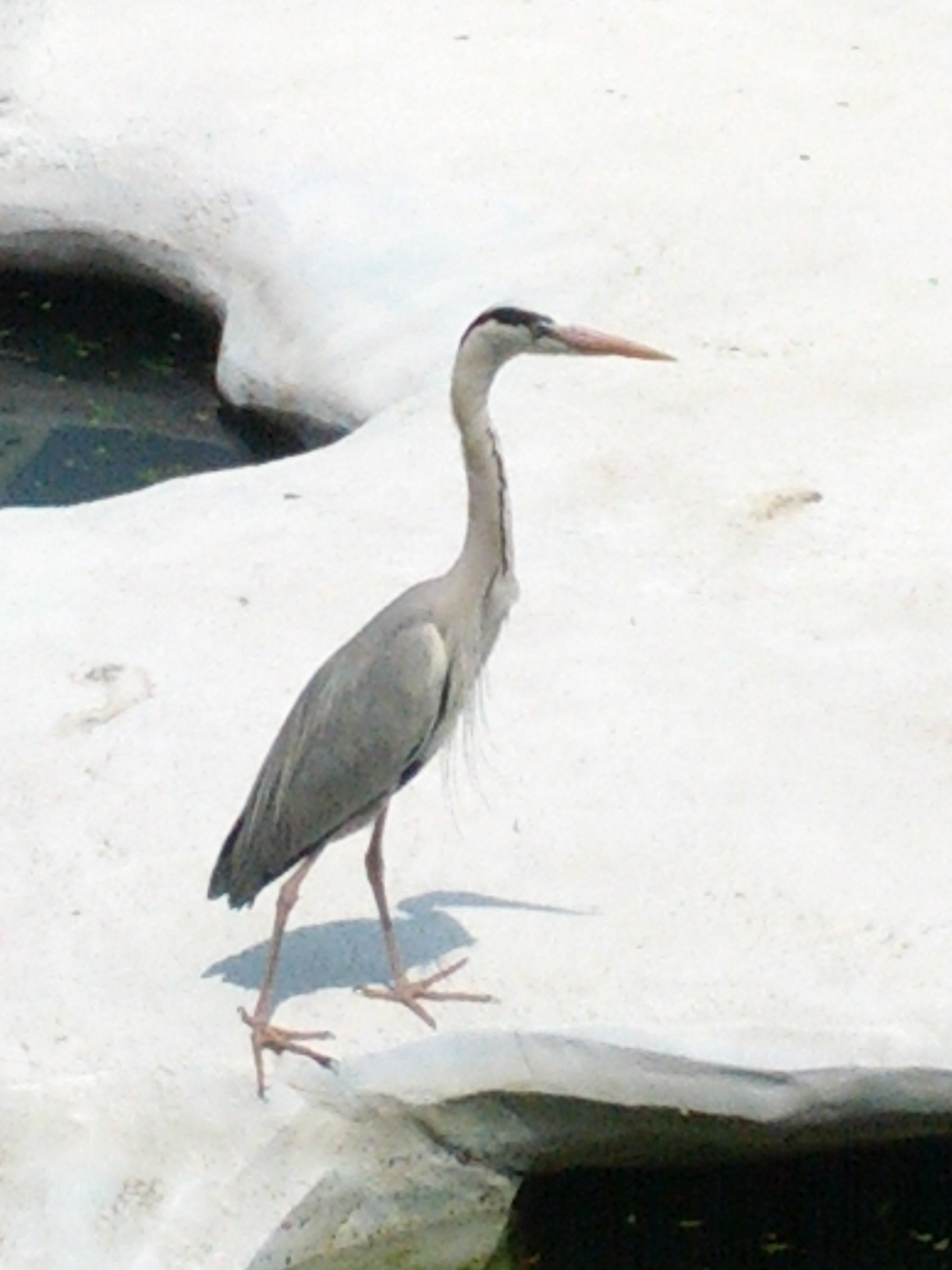
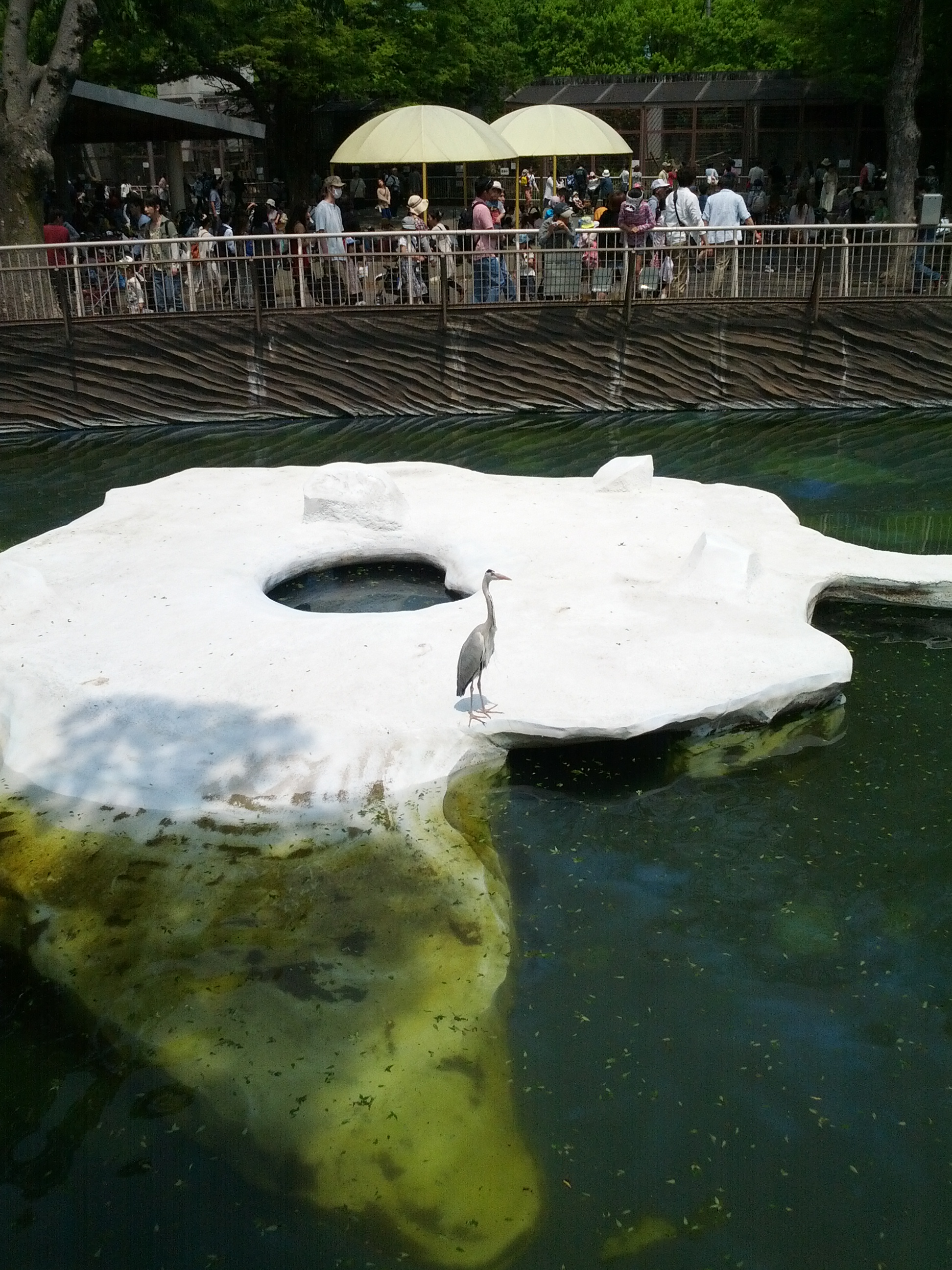
During Golden Week, I went to Akihabara. But before that, I went to the zoo. It was a national holiday, so the place was fairly packed, but the lines all seemed to move along pretty quickly. They had a lot of fun animals, and a couple boring animals, like a ring-tailed racoon. One of their racoons was fricking huge, too. Don't know how old he was, but the place must feed him all the garbage he wants. I went with Ioana and company, and one of the Philipinas, a biologist, mentioned that some of the enclosures were a bit small, and started talking about stereotypical behaviours. At that, a lot of the enclosures did seem a bit small, especially for a lot of the primates. Some of the primates had sufficiently large enclosures, but they were definitely the exception. There was one critically endangered or alive only in captivity (I forget which) primate that had an enclosure probably smaller than the room I'm in right now, which is pretty darn cramped. Looking for something different, I actually stumbled across some reviews of the zoo that all mentioned that it didn't seem to treat the animals too well, and also mentioned that this is somewhat typical of Japanese zoos. So, that's unfortunate. In the penguin or otter tank (I forget which), there was this cool bird, which at first we took to be a resident animal. But, finding no nameplate and noticing that there was no means of keeping it from flying away, concluded that it must just have been incidental. Japan has some cool birds just flying around. If anyone can ID this guy, let me know. I was in a bit of a hurry through the zoo, actually, as I had Jazz club later, so I didn't get to see the koalas or the botanical gardens that are attached to the zoo. I'll have to go back, I guess.
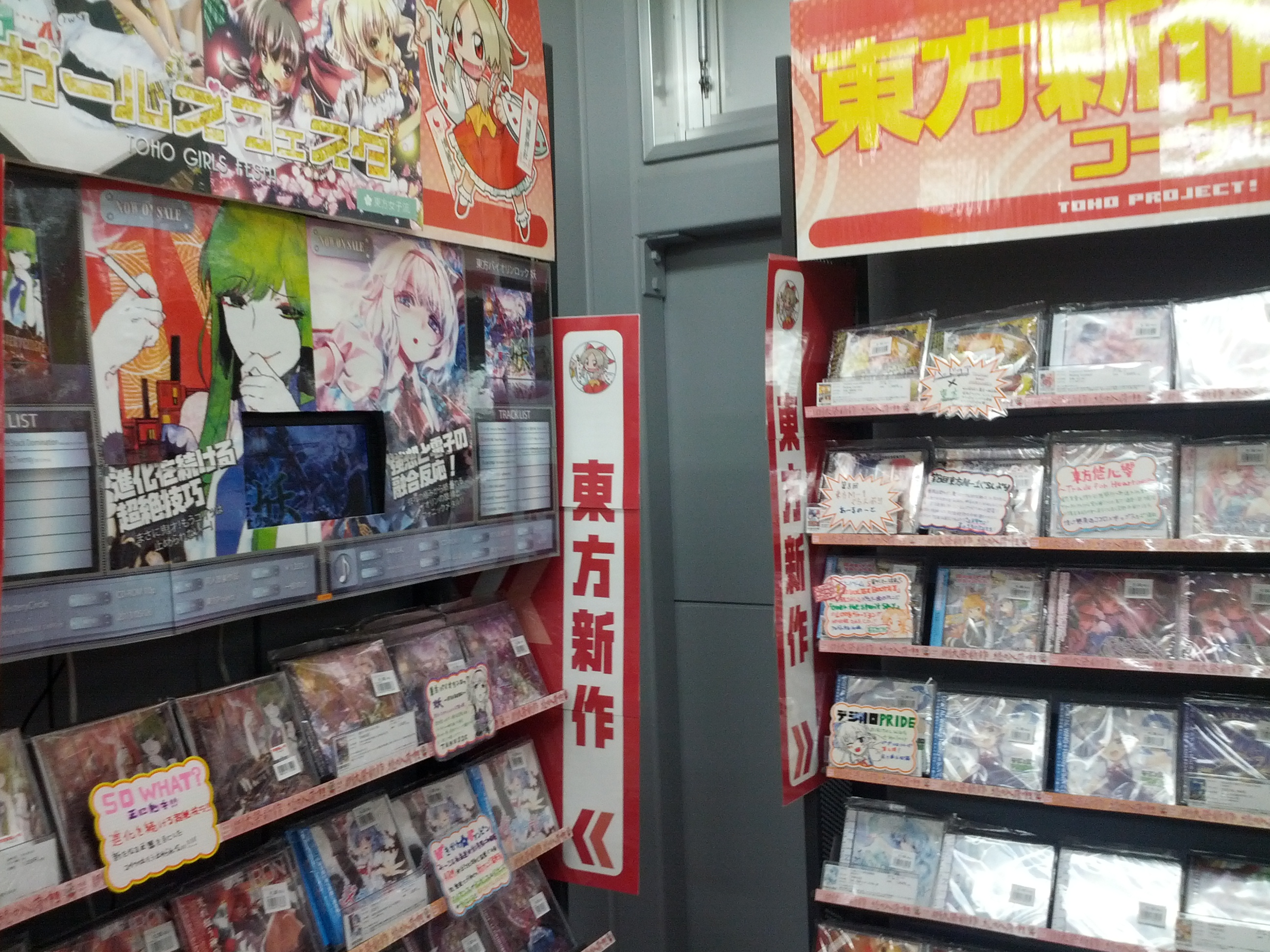
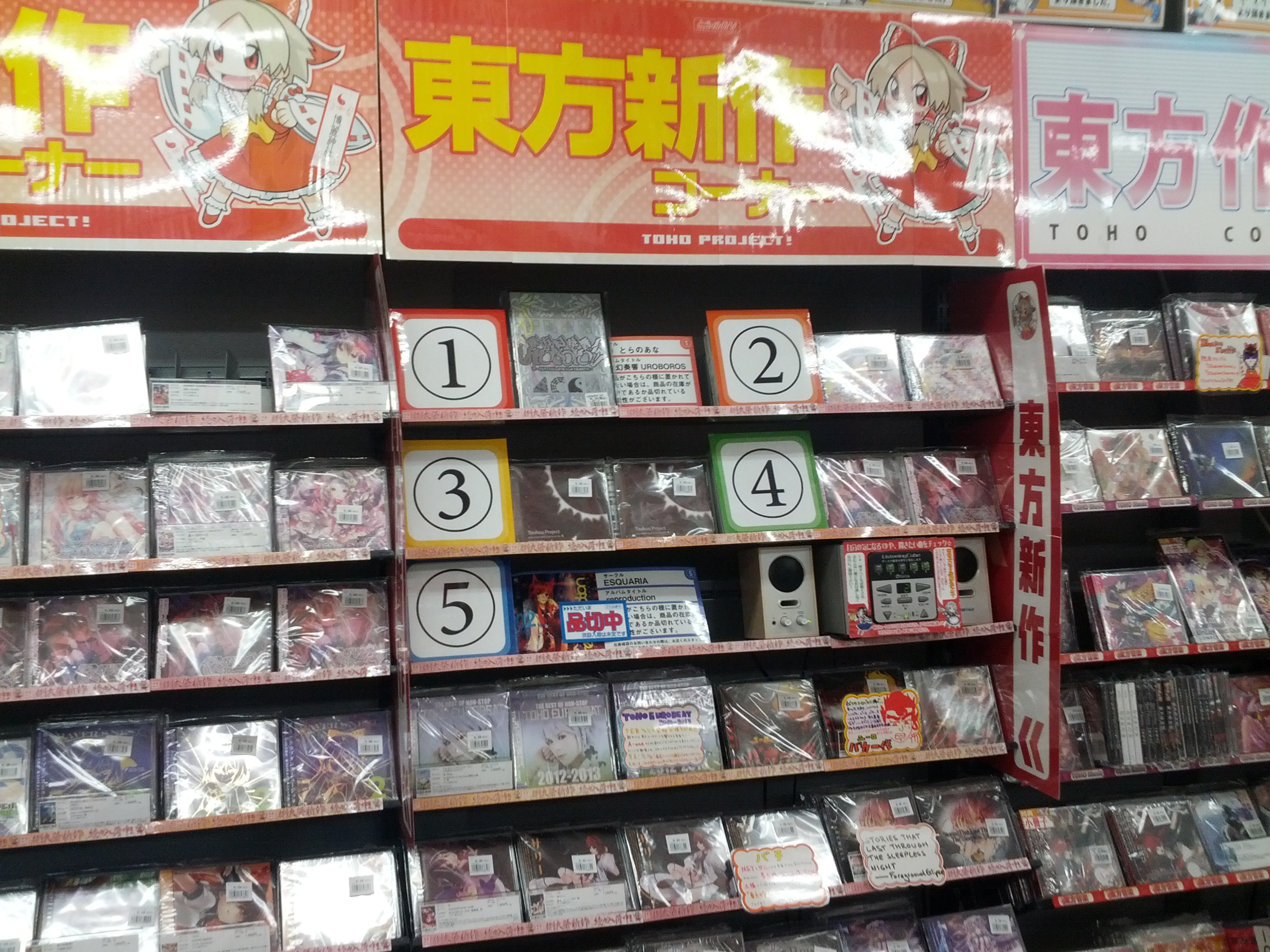
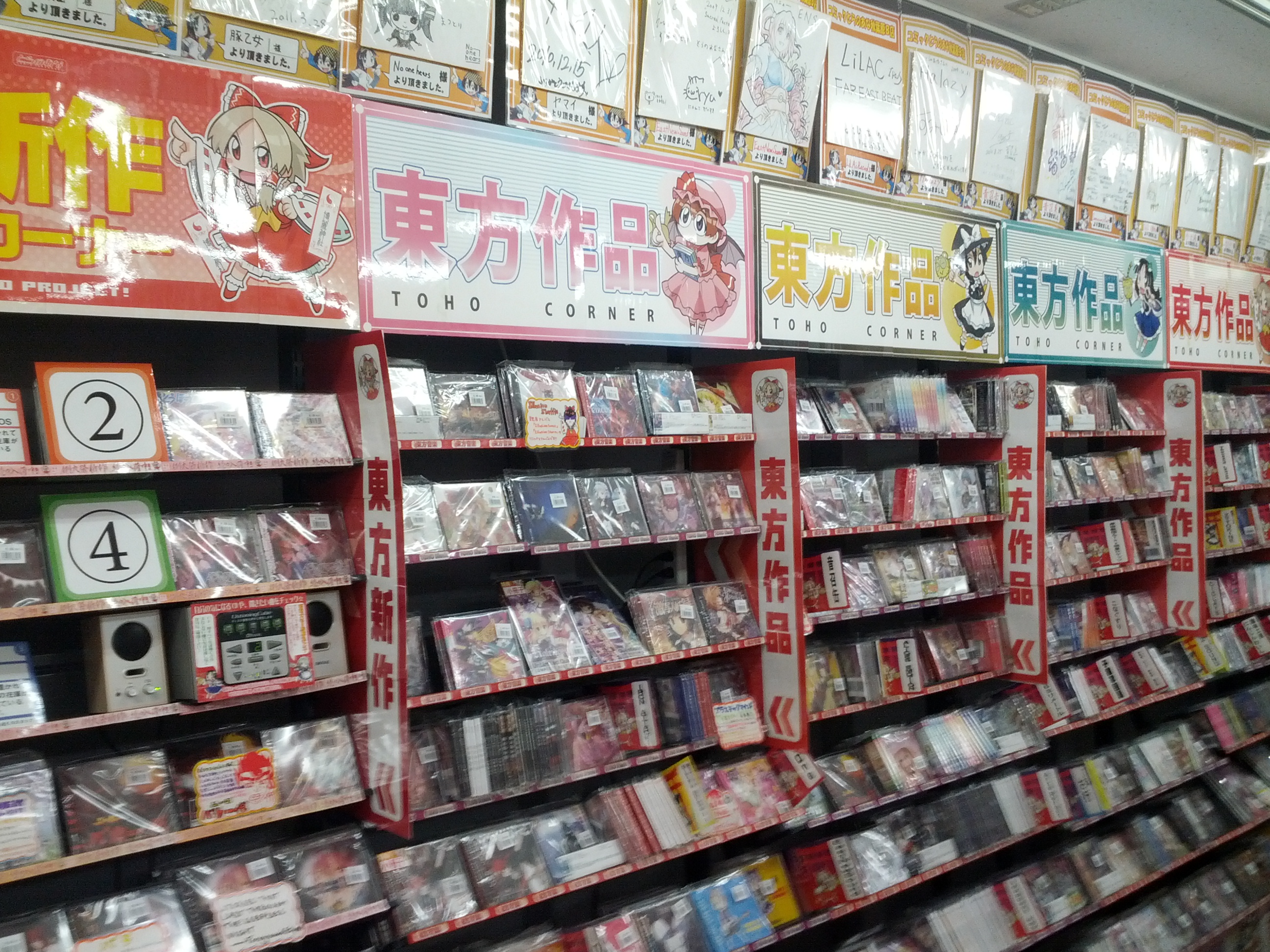
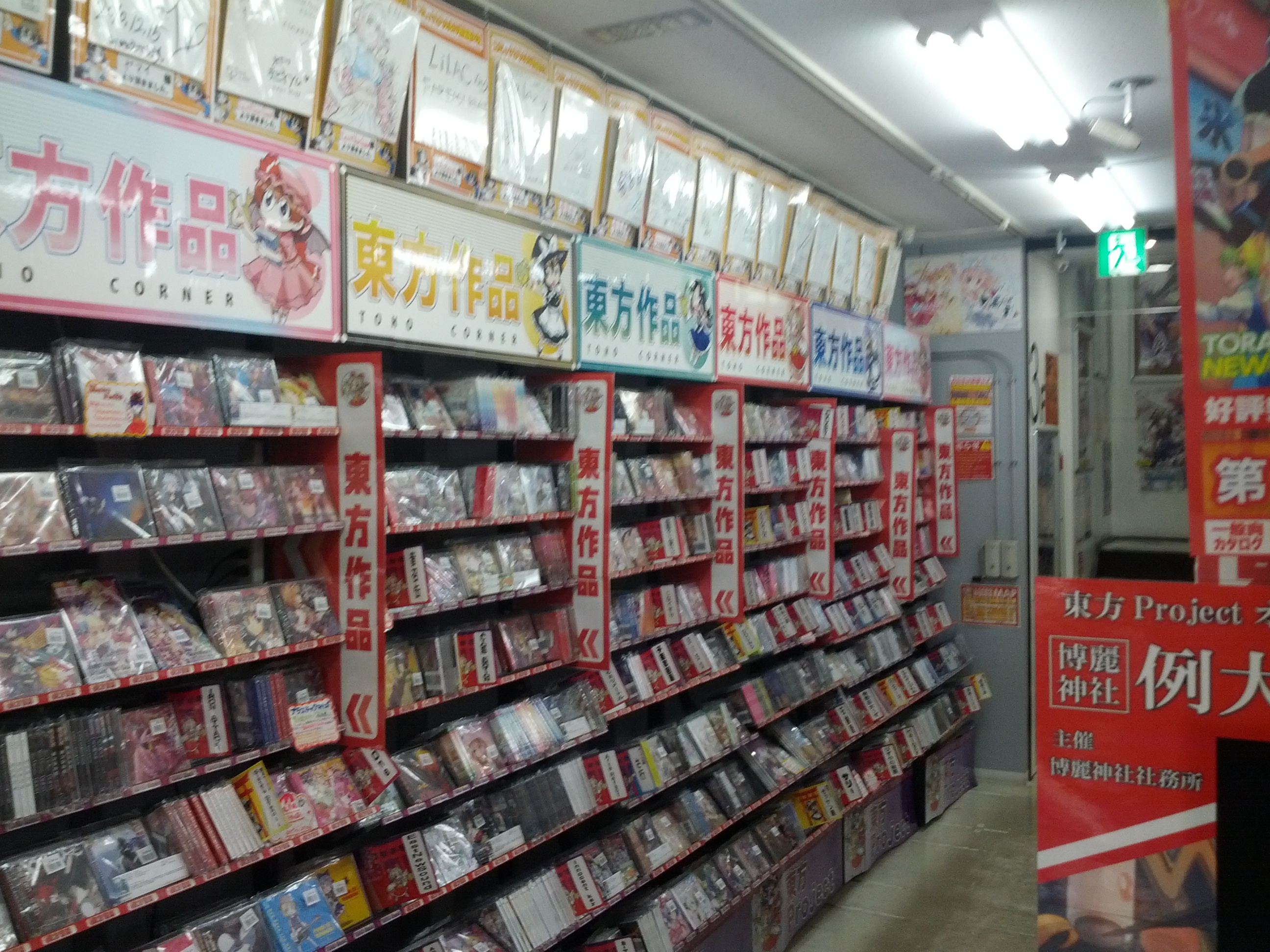
And then the next day, Sunday, I went to Akihabara. One of my teachers recommended, "Don't go anywhere during Golden Week. Every place is full. Well, actually, go to Tokyo. Everyone in Tokyo leaves during Golden Week." The place wasn't as pack-jammed as I might have expected, but there was still always a fairly think crowd wherever we went. I say "we;" I went with a Japanese guy named Keita, whom I met at one of the four or five welcome parties that were thrown by various organizations. We got along, got onto anime (he'd seen Haibane Renmei! That was so cool!), and agreed to go to Akihabara during Golden Week. We Shinkansen'd up, which took about 90 minutes. I got to see Mt. Fuji from the Shinkansen window, so that was cool. I made my oniigiri to eat on the way -- that was cool, too. And then we got to Akihabara, which was also very cool. First off, we went to the Tora no Ana and the Animate. I'd never heard of Tora no Ana (Tiger Hole), but it was a pretty cool place. They had loads of Doujinshi. I think that we didn't really understand the layout of the place, so we actually saw only about half of it; the "ladies' sections," which were essentially all the BL sections. Apparently, Kuroko no Basuke and Yowamushi Pedal are very popular among certain demographics. They always cropped up in fairly large numbers. I'd only ever seen Animate written, and it had never before occurred to me that it was an English word. I'd always pronounced it "ah-nihm-a-tay." Oops. That place was also very cool, having a rather large selection of merchandise of all kinds, but it was all a bit to pricey for me. I'm not that into merchandise, anyway. Also notable is the sheer volume of physical Touhou merchandise that was around. I always knew Touhou to live on the Internet; it was very interesting to see so much of it in physical form. Doujin comics and music and games and everything. This stuff actually gets released as physical media by these circles. I've known it intellectually, but seeing the amount of space it takes up gives you a new appreciation for the industry.
So Tora no Ana and Animate were fun, even though I ended up not buying anything. After that, we found a game store, and I got one of the things I did not want to leave Japan without: a Mother 3 cartridge. Yeah, some of you will know what I'm talking about. The rest, you may have heard of a game called Earthbound on the SNES, if only as the origin game for Ness in the Super Smash brothers franchise. Earthbound is actually the second game in the Mother trilogy, having been preceded by a title on the NES that was slated to be released in the US, and was actually fully localized for North american release, but was dropped due to its being a little-known title that came very late in the NES lifecycle (I think the SNES had already been released); and was followed by a title on the GBA, though it was originally slated for the N64 with Disc Drive add-on. Earthbound is the greatest video game I have ever played. I love it. It does things with the medium that I have never seen another game do. So I really wanted, and was really happy to find and purchase, a Mother 3 cartridge. So that was a great success in Akihabara.
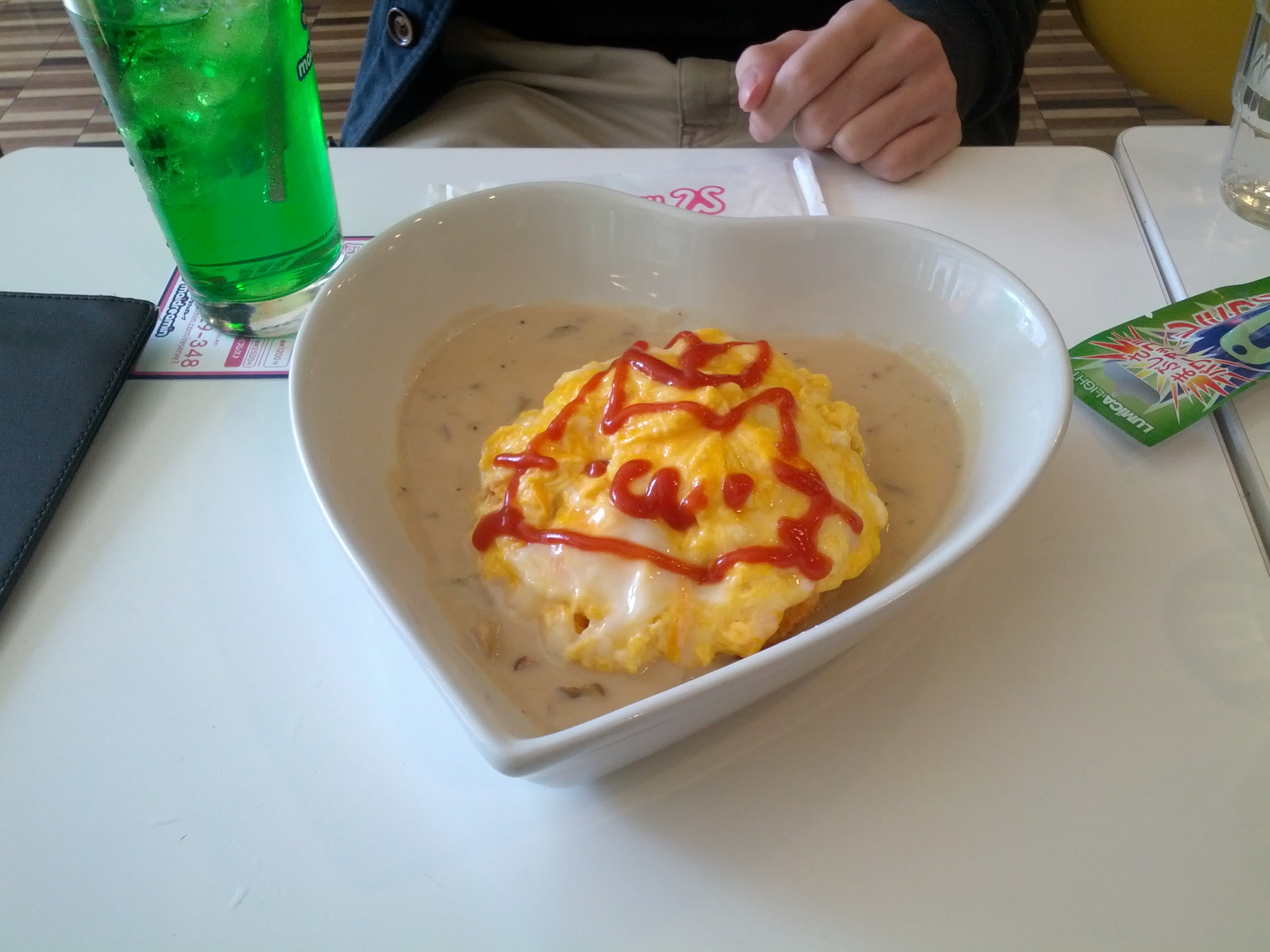
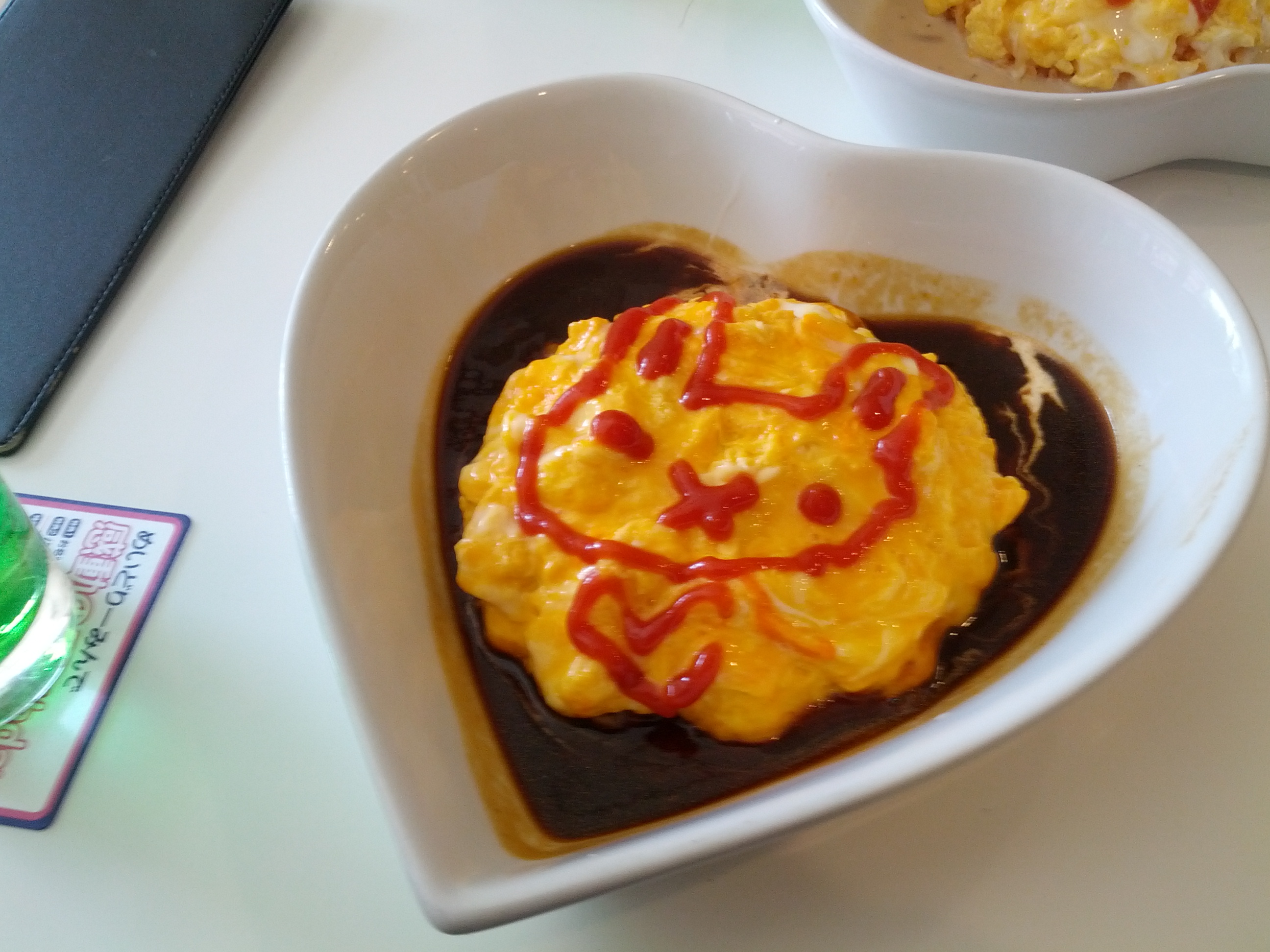
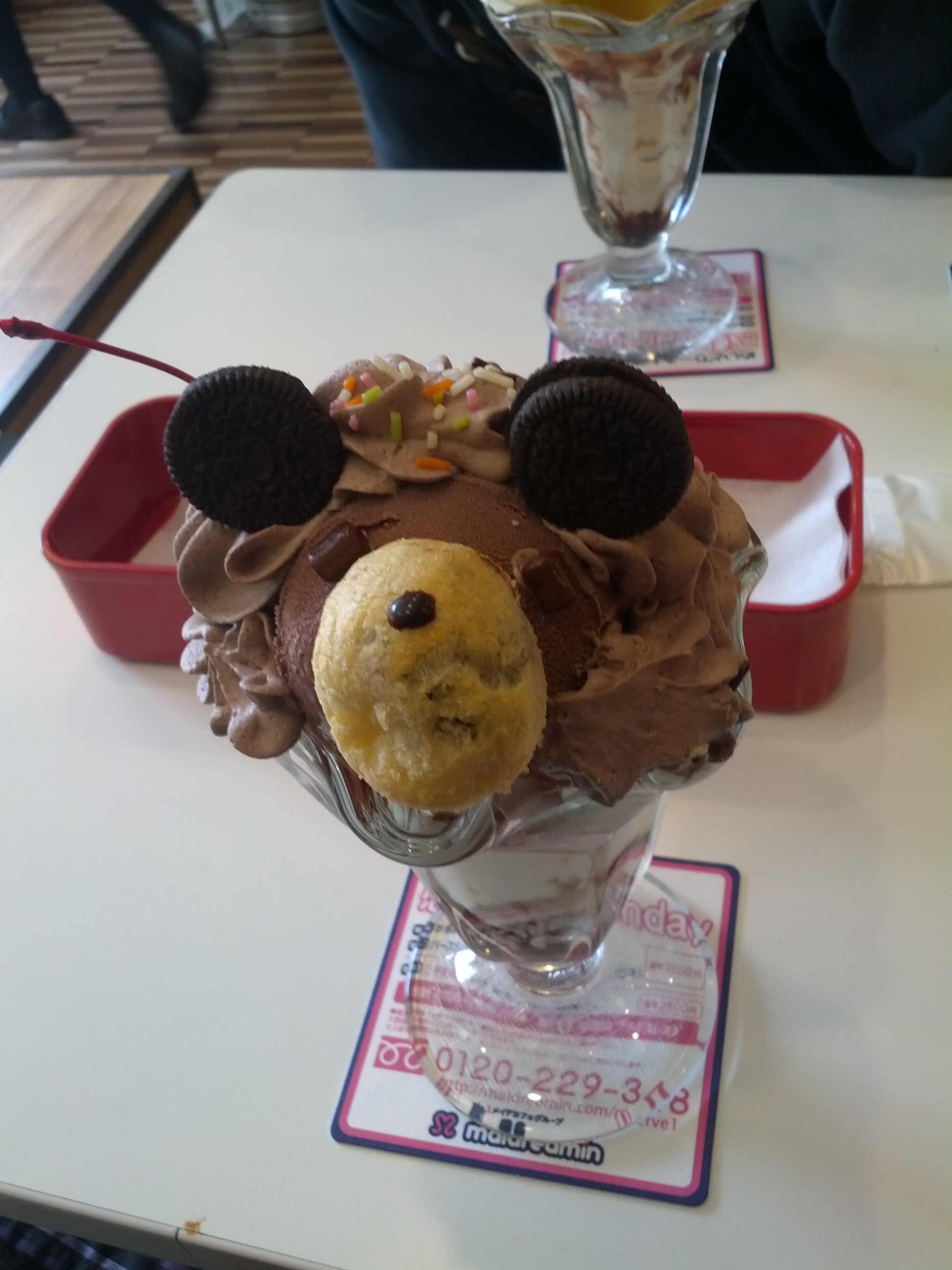
Another great success was going to a Maid Cafe. One of the reasons I went to Akihabara, besides just to "make the pilgrammage," as it were, was to go to a maid cafe, and see what it was really like. We went to Maidreamin', which is apparantly a chain of some sort, located on the third floor of some building. I was very glad to have Keita there, because I could not understand much of what the fast-talking witstaff was saying. I don't think that anyone called me "Goshujin-sama," though it was written on the member card they gave me. The food was actually pretty decent; as tradition dictates, Keita and I both got eggs-on-rice: he, over white sauce with a kitty, and I, over demiglaze sauze with a bunny. In discussing the experience with some people afterwards, it seems they invariably ask, "Were there cute girls?" Of course there were cute girls. You don't get hired in a maid cafe if you can't manage cute. Costumes notwithstanding, the biggest difference between a maid cafe and any other cafe is the various service routines. Upon serving food, the waitress will teach you a short charm, which you then repeat with her: "Now, be delicious, moe, moe kyuu!" accompanied with a motion with the hands forming a heart shape. There were also some animal-ear headbands hanging from a wall, which were variously worn by customers, mostly if they opted to take a commemorative photograph, as I did. I got the There was one middle-aged guy with bleached hair who was smoking the whole time behind our table who asked to take a picture with me with sheep ears. Okay, sure. At one point, one of the waitresses got up on a small dias and performed an awkward, uninspired dance to dim lights and the store's -- the chain's, probably -- theme song. All the customers had been given lightsticks to wave around, but we were also supposed to clap or something, which made it somewhat difficult to do the light motions, or something. Then, I had some ice cream, and we took your leave.
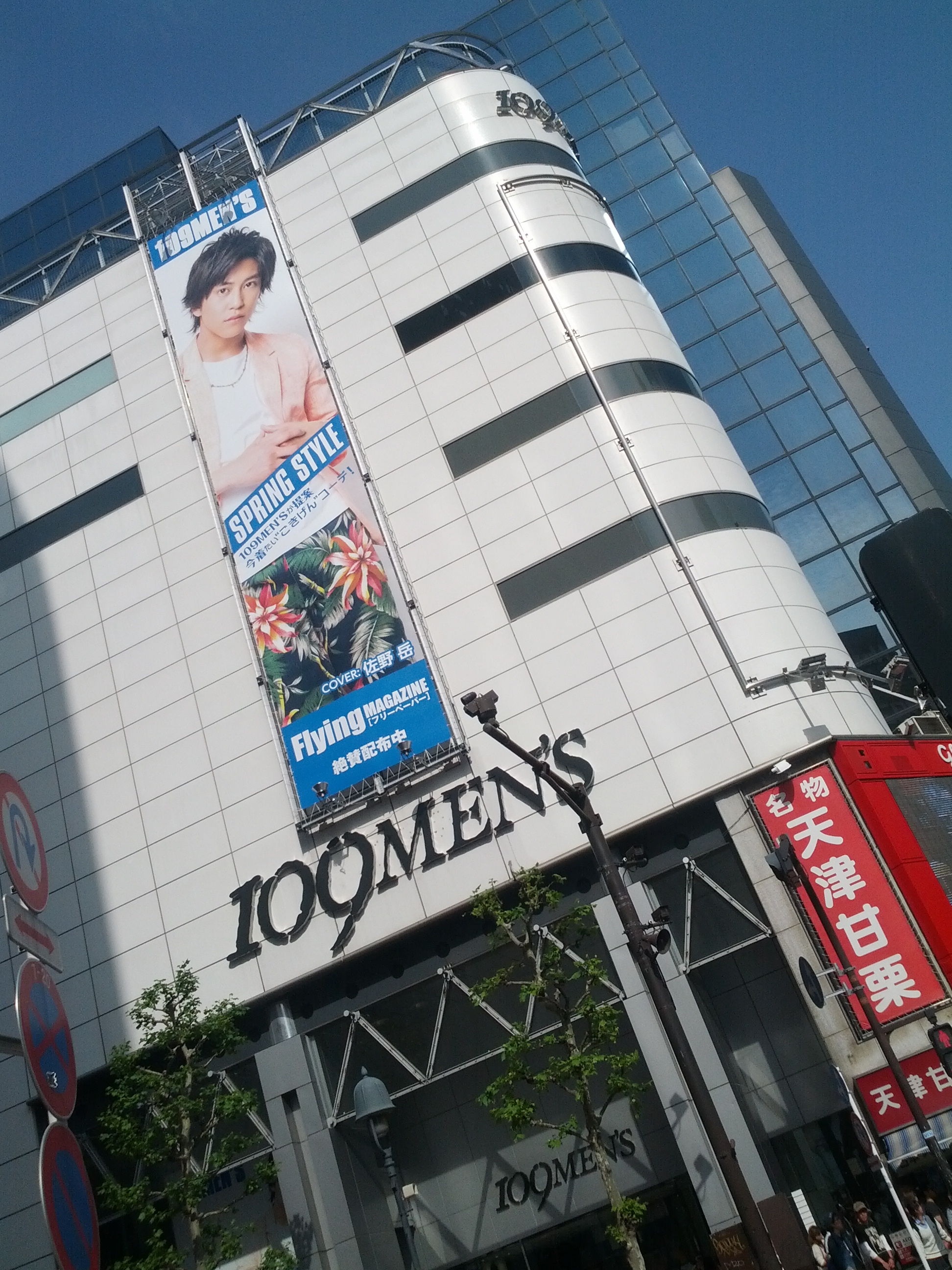
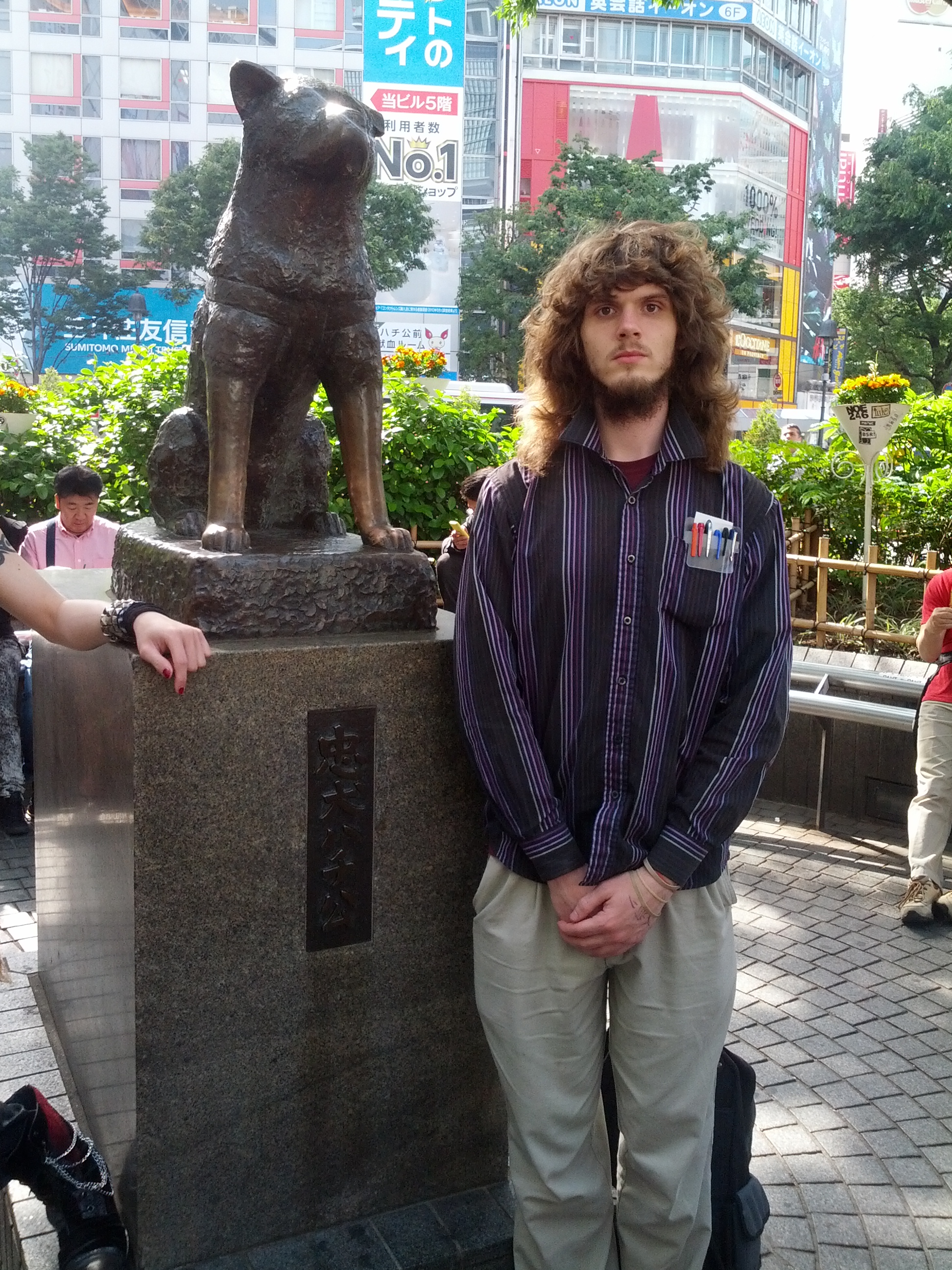
And I think that that was more or less it for Akihabara. I might have gone to a game center. I know that we spent a fair bit of time walking around soaking in the sights, enjoying the large advertisements for anime series and light novel releases. We went into one hole-in-the-wall shop, which seemed like it had a fairly decent selection of stuff, especially models, but nothing I was interested in. A lot of posters were labled with a series name, and nothing else. I might have gambled on one, but I didn't want to take the time to sort through all the Gundam and company stuff. So after that, we visited Shibuya. This was mainly my impulse, because I love The World Ends With You so much. It also does some things that other games don't do. So I went to Shibuya, and walked around a bit. I was able to recognize some stuff from the game, which was cool. I saw the 109 building, and, of course, took a picture with Hachiko, the faithful dog. (Are you there, Hachiko-chan? I'd love it if you were...) Taking pictures with Hachiko is a fairly popular thing to do, so there was a crowd, and I had to wait my turn. I saw the Moai, too, but I didn't get a picture of it. Oh, and I walked across the scramble crossing. I took a shakycam video of the experience. That was fun. Just walked aroud Shibuya a bit, recognizing things from The World Ends With You, and then we went home. So that, in short, was my visit to Akihabara. I'm glad I went. Oh, wait! There's a detail I need to tell you. All this time, I was speaking Japanese, but Keita was speaking English. So you had this white guy walking around talking in bad Japanese, and this JApanese guy walking around talking in okay English. He told me later that he's an aerospace engineer, and he wants to go to to some aeronautics conference that's held in English, and he can't attend if his English isn't good enough. If Id'a known that, I might have spoken a bit of English back to him. As it was, I got some practice speaking Japanese, but not much listening.
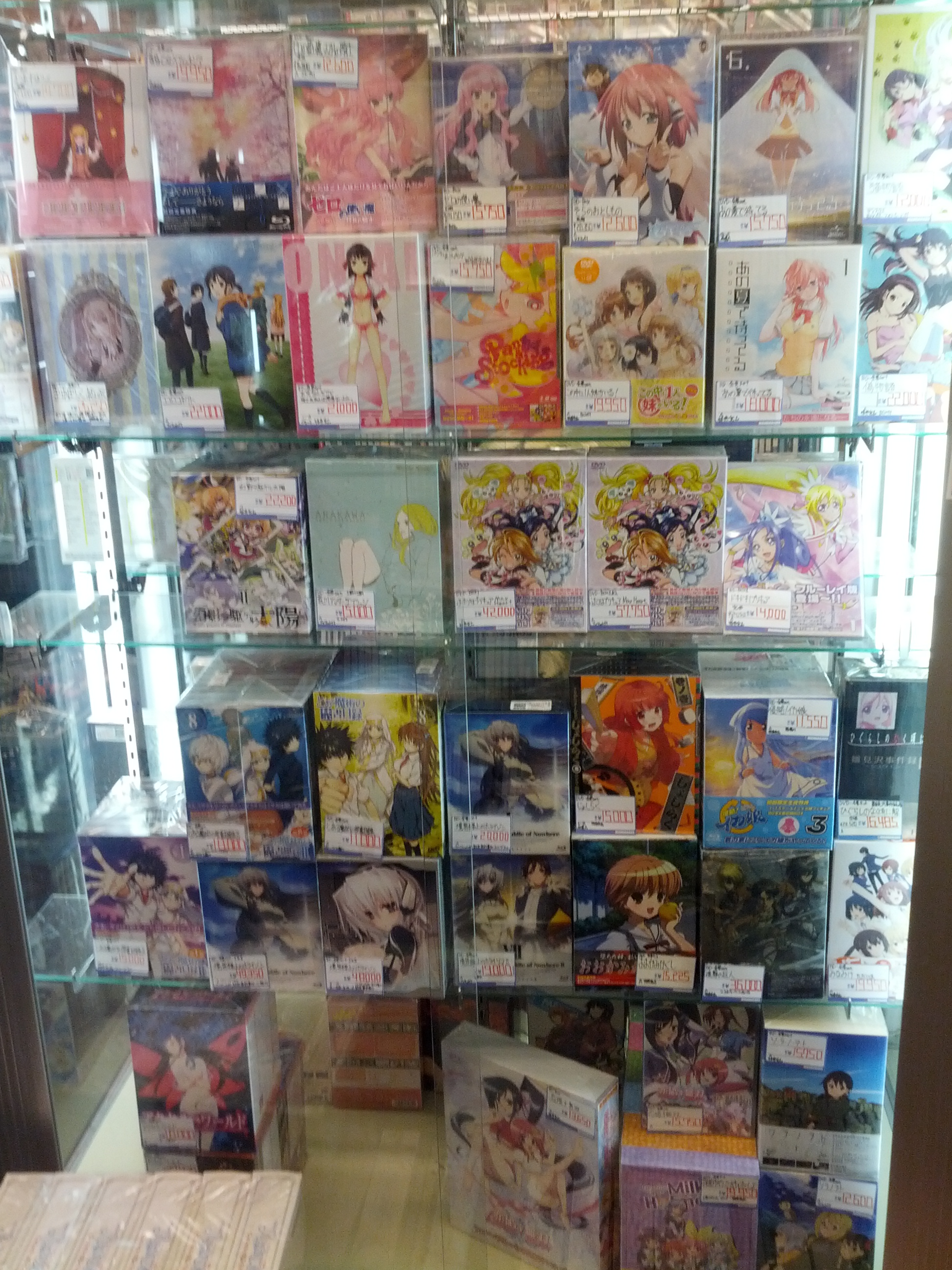
Then, the next day, not according to any plan of mine, I went to Osu. Osu is the closes thing Nagoya has to an answer to Akihabara. I was just out throwing out some trash or something, and I ran into a German that I'd had some contact with before. He said he was going to Osu, and invited me. I'd been meaning to go, because that's where Mandarake, the giant manga store, is. I'll probably get most of the stuff I want there, but I need to check the big secondhand chain Bookoff first. I hear there's one not too far from here. So I went with this German to Osu. And Mandarake was pretty cool. The store is about four floors tall, and most floors specialize in a different kind of merchandise. The first floor is manga, video games, and random collectable crap. The second floor was mostly anime and music, I think. I'm pretty sure that that's where they had this display case full of anime. I include this photo mostly for the prices, which you can see if you zoom in a little. This stuff is effing expensive. If you've heard the rumours, they're true. So I'm not gonna buy any discs while I'm here. They're all region 2, anyway. I'll spend my money on paper instead. The third floor was...what? Cosplay stuff? I think the third floor was mostly models, and games. Right. They had some software. Lots of Touhou stuff again. I actually saw a physical Touhou Soccer disc. And there was some Touhou-themed image editor called "Photewishop." Wonder what that's like. It was the fourth floor, I think, that had cosplay and porn. I didn't want t spend much money, having just spent a whole big wad of it in Akihabara, but I did want to at least scope the place out, as I'll probably get most of the comics I want to buy while I'm here there. However, I checked, and I came across another thing that I didn't want to leave Japan without. You've already seen me mention Hanjuku Joshi once or twice. It was there at the Mandarake, and I scooped it. I've been reading it again in the original, and it's still so good. It remains the greatest yuri work I've yet encountered. So glad I bagged it.
Like the week after that, I went to an onsen. This came about orighinally from playing Smash with a fellow American who lives in Ohmeikan, the dorm where people can actually rub elbows with Japanese people, due in part to the common rooms that are stocked chock-full of video games from the Famicom onwards and man, many comics. There were some Japanese people playing Mahjong, actually, when I got there, and I was able to jump in for a few hands while we waited for the TV to become available. It was a tutorial game, so most of the players didn't really know the rules and there weren't any points, but it was still good to play a few hands. I think I even won a couple -- cheap Yaku Pai hands with White Dragons. But it's cool. Anyway, after playing some Smash, I was invited on an Onsen trip. Originally, the American I was playing with was going to come, too, but he had schoolwork or something, so he couldn't come. This trip turned out to be a very good linguistic experience, and in that respect, it was probably better not to have anothe Anglophone around. It was one of the few times that I was treated as a conversational equal. I was able to just talk to people, to participate in norml conversation, which is previous rare. The Jazz club had a big welcome party for new members last weekend, and that was another one. It felt soooo, soooooooooo GOOD! Just to hang around and see words used in proper contexts -- I could feel my brain building networks of meaning, attaching meaning to words, and associating words with other words. It was simply amazing. If I had something like that every day, I would be speaking Japanese much, much, much, much better than I am right now. But because my stimulus is so impoverished, I'm moving at a pace I find unsatisfactory. The trip's really kind of been a bust in that respect -- I feel like I have a decent linguistic environment once or twice a month. Can't do much with that.
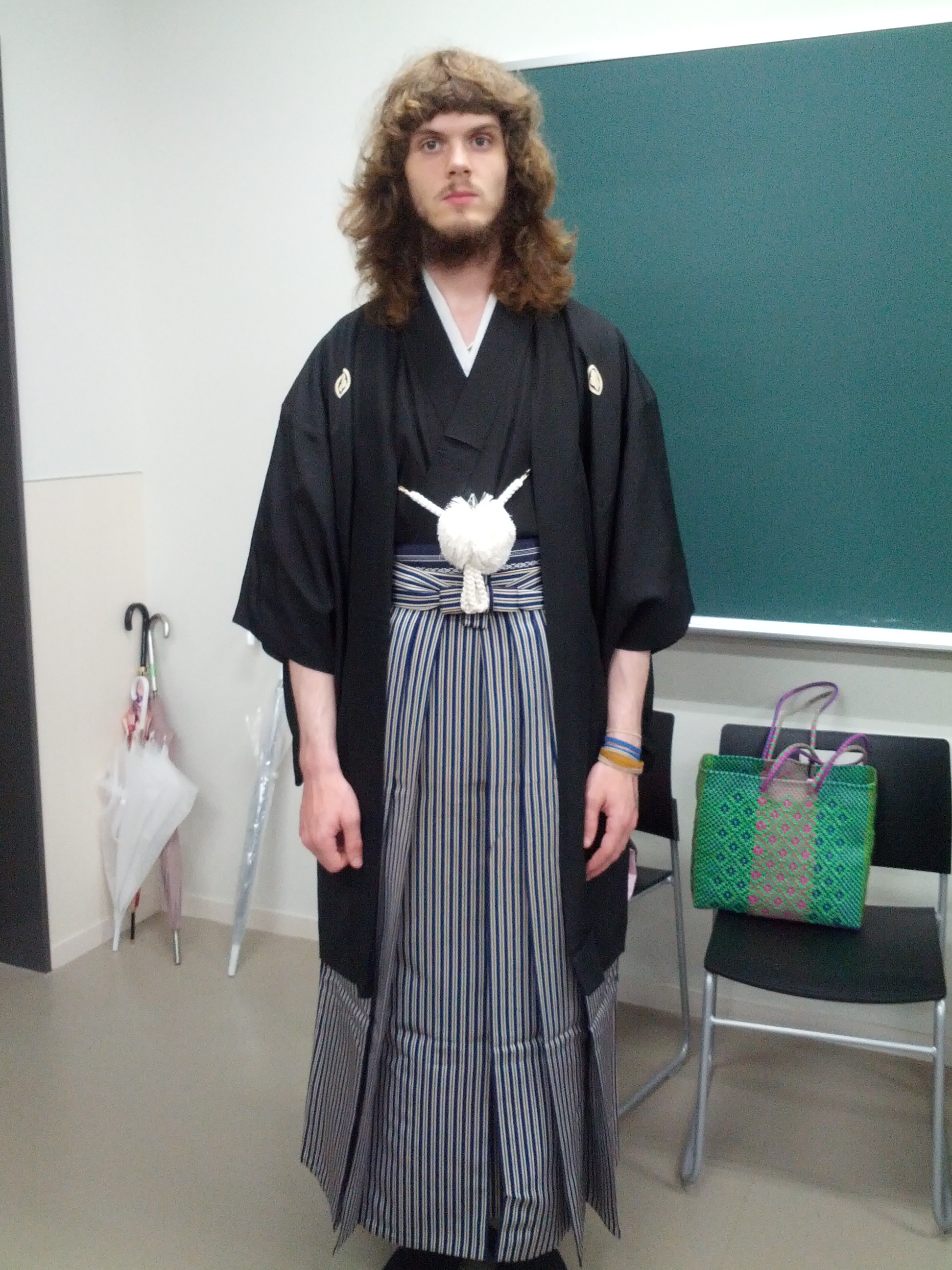
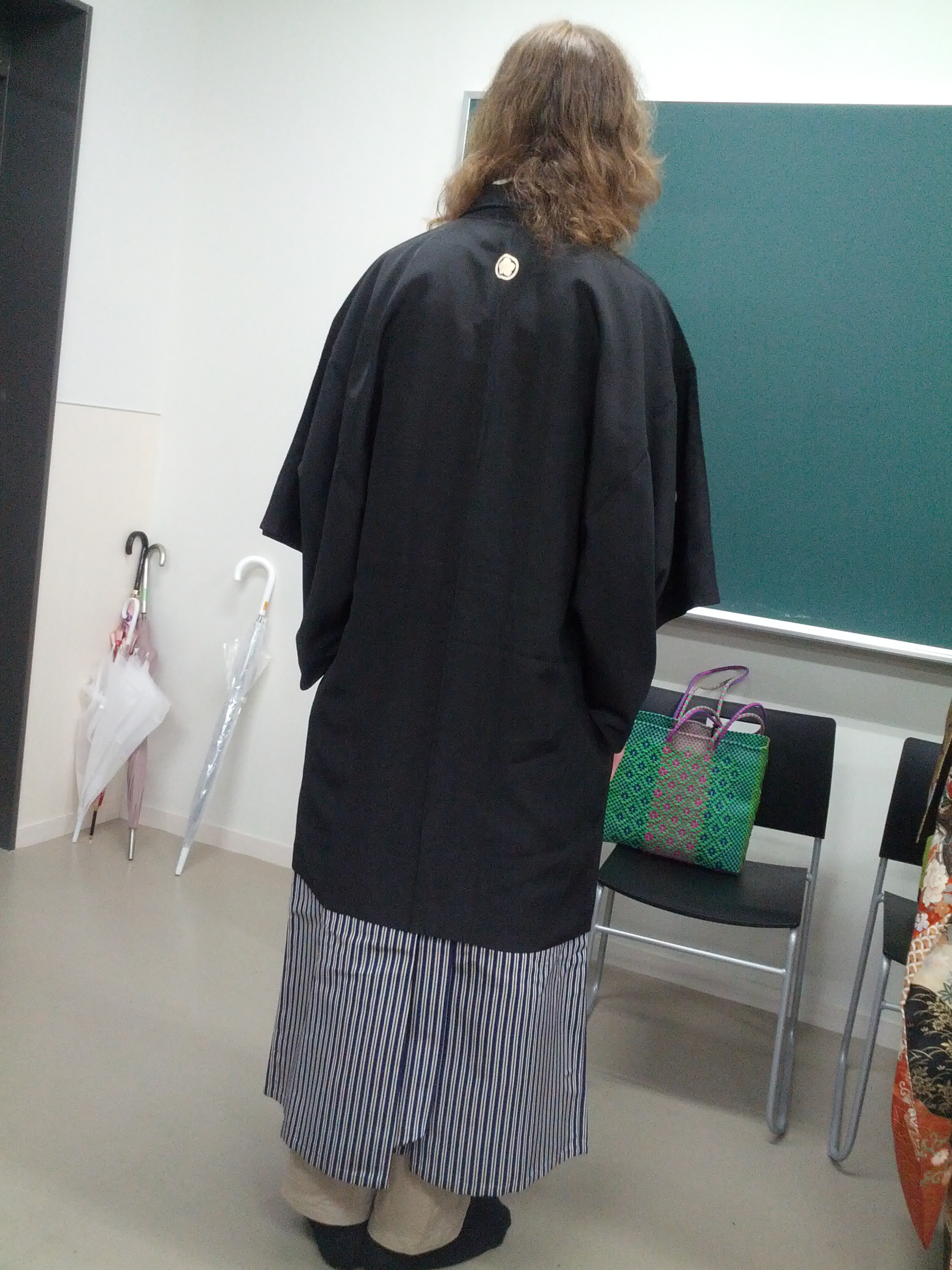
This doesn't have much of a place anywhere else, so I'll put it here. There was a class on kimono a while ago, and I participated. I volunteered to wear the most formal kimono, which included something like a hakama, but it wasn't divided, so I don't think it was a hakama. Here's the front and the back.
And I think that's everything important. Oh! No! The Jazz club finally handed me a part! I'm very happy about this. I finalyl get to play in a group again! This means, however, that I need to be sure to keep my chops up. I feel like I've been doing pretty well with the trumpet, actually, which is exciting, but it's kind of one of those "one step forwards, two steps back" things. You get better, then you don't do as well, so you need to get it back. Consistency was never one of my strong points, but I'm working on it. Getting stronger. Motto SPARKING nau. Takaku. TOUGH na HAATO.
So now I think I'm done for now for real. 'Till next time.